How Does Facial Recognition Work?
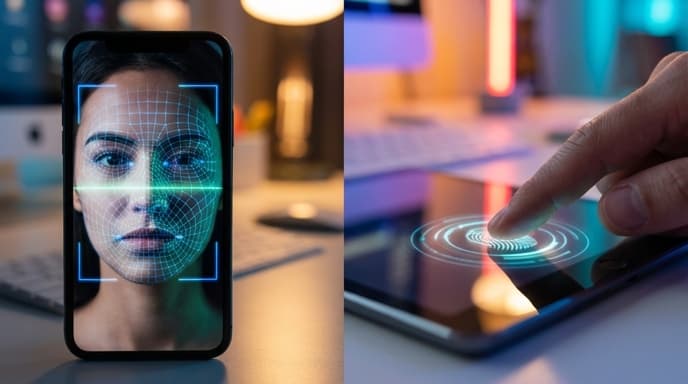
Modern facial recognition, like Apple's Face ID, is far more than just a camera. It uses a sophisticated system of infrared dots and sensors to project and analyze thousands of points on your face, creating a precise 3D depth map. This map is then encrypted and stored securely within a special chip on your device called the Secure Enclave. It's not a photograph; it's a complex mathematical representation of your facial geometry. This 3D mapping makes it extremely difficult to fool with a simple photo or mask.
How Do Fingerprint Scanners Work?
Fingerprint scanners have evolved over the years, but they all aim to map the unique ridges and valleys of your fingerprint.
- Optical Scanners: These are the oldest type, essentially taking a 2D photograph of your finger. They are common on less expensive devices and can sometimes be fooled by a high-quality print.
- Capacitive Scanners: These use tiny capacitors to measure the electrical charge differences between the ridges (which touch the sensor) and valleys (which don't) of your finger, creating a more secure digital map.
- Ultrasonic Scanners: The most modern type, found on many high-end Android phones. They use ultrasonic sound waves to create a highly detailed 3D map of your fingerprint, which works even if your finger is wet or dirty.
The Security Showdown: Which is Safer?
When comparing top-tier technologies—like Apple's Face ID versus an ultrasonic fingerprint scanner—the security level is exceptionally high for both. However, experts generally give a slight edge to 3D facial recognition.
Face ID's Advantage: The complexity of a 3D facial map is incredibly high. Apple claims the probability of a random person unlocking your iPhone with Face ID is 1 in 1,000,000, compared to 1 in 50,000 for their Touch ID fingerprint sensor. It is extremely difficult to create a mask that can replicate the depth and detail needed to fool the system.
Fingerprint's Vulnerability: While modern ultrasonic sensors are very secure, less advanced optical and capacitive sensors have been fooled by sophisticated methods involving lifted prints and 3D-printed molds. The primary security difference often lies in the quality of the sensor being used.
Convenience and Reliability
Security isn't the only factor; usability matters. Here, the winner is less clear.
- Facial Recognition: It's seamless and hands-free. You just look at your phone. However, it can struggle with masks, certain sunglasses, or when the device is lying flat on a table at an awkward angle.
- Fingerprint Scanners: They are extremely fast and work from any angle, even when you can't see your screen. In-display sensors feel futuristic, but their reliability can vary. They also work flawlessly while wearing a mask.
Frequently Asked Questions
Can police force me to unlock my phone with my face or finger?
In the U.S., legal precedent is complex and varies. Courts have generally ruled that you can be compelled to provide a biometric identifier (like a fingerprint or face scan), but you cannot be forced to reveal a memorized passcode (which is protected by the Fifth Amendment). This is a key reason some people prefer a strong passcode.
What about identical twins?
This is one area where high-quality fingerprint sensors have an advantage. While identical twins have unique fingerprints, their facial geometry can be similar enough to fool some facial recognition systems, including Face ID, though it's rare.
Is one better for mobile payments?
Both are considered highly secure for authenticating payments. The choice between them is purely a matter of user preference and convenience at the checkout counter.
Key Takeaways
- Advanced 3D facial recognition (like Face ID) is generally considered slightly more secure against spoofing than most fingerprint sensors.
- Ultrasonic fingerprint scanners offer a very high level of security, far surpassing older optical versions.
- Facial recognition offers hands-free convenience but can be hindered by masks or odd angles.
- Fingerprint scanners are fast and reliable but require physical contact.
- Both biometric methods are significantly more secure than a weak, easily guessable passcode.
Suggested Internal Links
Learn more about digital security:
- What Are Zero-Knowledge Proofs? The Future of Digital Privacy
- Do You Really Need a VPN for Your Home Wi-Fi? The Answer Isn’t Simple
Sources for Verification
This article synthesizes information from security white papers published by Apple and Google, along with analysis from independent cybersecurity publications and tech review sites.