What is RAG (Retrieval-Augmented Generation)?
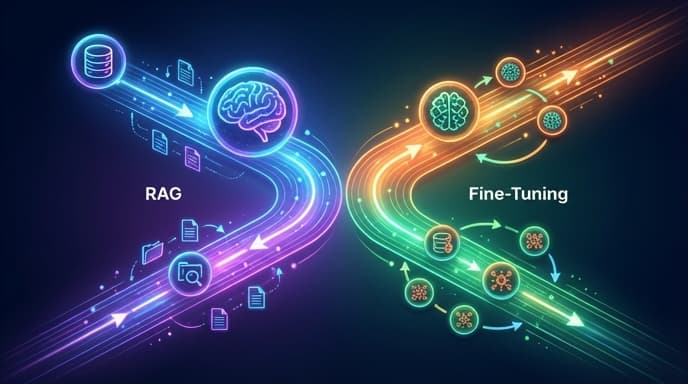
Imagine giving an AI model access to a specialized, up-to-the-minute library. That's essentially what RAG does. Instead of relying solely on its pre-trained knowledge, a RAG system first 'retrieves' relevant information from an external database (like your company's internal documents or a live news feed) and then uses that information to 'generate' an answer. It's like an open-book exam for the AI.
When is RAG the Best Choice?
- When you need answers based on recent or proprietary information.
- When factual accuracy and source citation are critical.
- When you need to reduce the risk of the AI 'hallucinating' or making up facts.
- When you want a faster, more cost-effective way to incorporate new knowledge.
What is Fine-Tuning?
Fine-tuning is more like intensive tutoring for the AI. It involves taking a pre-trained model and further training it on a smaller, specific dataset. This process doesn't just give the AI new information; it adjusts the model's internal parameters, effectively teaching it a new skill, style, or specific knowledge domain. It's a deeper, more permanent change to the model's core behavior.
When is Fine-Tuning the Best Choice?
- When you need the AI to adopt a specific tone, voice, or format.
- When the knowledge required is stable and doesn't change frequently.
- When you are teaching the AI a new, complex reasoning skill that can't be explained in a simple document.
Key Differences: RAG vs. Fine-Tuning at a Glance
Making the right choice comes down to understanding the trade-offs between these two powerful techniques.
Cost and Speed
RAG: Generally cheaper and faster to implement. The main cost is setting up and maintaining the external database. You aren't retraining the entire model.
Fine-Tuning: Can be computationally expensive and time-consuming, requiring significant data preparation and processing power to adjust the model's weights.
Knowledge Management
RAG: Excellent for dynamic, changing information. To update the AI's knowledge, you simply update the external database. It's easy to add or remove information.
Fine-Tuning: Best for static information. Updating the knowledge requires a new round of fine-tuning, which can be a complex process.
Accuracy and Hallucinations
RAG: Significantly reduces hallucinations by grounding the AI's answers in specific, retrieved documents. You can easily verify the source of the information.
Fine-Tuning: While it can improve accuracy within its domain, it can still hallucinate if pushed outside its specialized training data.
How to Choose: A Simple Guide
Ask yourself these questions:
- Does my AI need access to real-time information? If yes, choose RAG.
- Do I need my AI to mimic a specific writing style or personality? If yes, consider fine-tuning.
- Is my budget and timeline limited? If yes, start with RAG.
- Is it critical to cite sources for the AI's answers? If yes, RAG is the clear winner.
In many advanced applications, a hybrid approach is used, where a fine-tuned model is combined with a RAG system to get the best of both worlds: a specialized style and access to current, verifiable facts.
FAQ: RAG vs. Fine-Tuning
Can you use both RAG and fine-tuning together?
Yes, and it's often a powerful combination. You can fine-tune a model to understand a specific style or format, and then use RAG to provide it with up-to-date factual information.
Is RAG a replacement for fine-tuning?
No, they solve different problems. RAG is for knowledge injection, while fine-tuning is for skill and behavior adaptation.
Which is better for a customer service chatbot?
It depends. RAG is excellent for answering questions based on a knowledge base of product manuals. Fine-tuning might be used to teach it a friendly, on-brand conversational style.
Summary: Key Takeaways
- RAG is for knowledge: It gives AI access to external, up-to-date information without changing the core model.
- Fine-tuning is for skill: It adapts the AI's behavior, style, and core understanding through further training.
- RAG is faster and cheaper: It's easier to implement and update for dynamic information.
- Fine-tuning is deeper but more complex: It's powerful for creating specialized models but requires more resources.
- The best solution might be a hybrid: Combining both methods can offer the most robust and capable AI system.